Showing posts with label Dharmendra. Show all posts

Monday, 21 January 2013

Pyaar Kiya To Darna Kya

Directed by: Sohail Khan
Starring: Salman Khan, Arbaaz Khan, Kajol, Dharmendra
Released: 1998


Who wouldn´t immediately think about the iconic song from Mugal-E-Azam upon hearing this film´s title, right? Well, there are no palaces and princes in this one. It is pretty much all Salman Khan in his pre-lazy period rocking the screen. Nice colours, nice music, nice story, I really found Pyar Kiya To Darna Kya, directed by the youngest of three Khan brothers, supported by the fame of the eldest and giving job to the middle one, an endearing venture. In a way it reminded me of DDLJ, mainly because the plot is driven by an idea of young man butting into the girl´s family, trying to win their affection, and to top it the girl yet again is none other than Kajol, but it is really just a similarity and no rip-off I believe.


Muskaan (Kajol) is an orphan, living in a village with her still dashing uncle (Dharam Paaji) and elder, somehow grumpy brother Vishal (Arbaaz), who really doesn´t talk much, neither he likes others to talk much. Other characters we get introduced to are Muskaan´s friend Ujala, who has more than a crush on Vishal (he seems to be completely oblivious and uninterested, even after she throws some uber-sexy dance in his way) and a home cook, who has no role really, but I believe he deserves a mention for the proud presentation of some really weird wardrobe.

Indeed.
The same awful thing is to be used as a punishment for the hero.
Vishal is greatly concerned for Muskaan, she being his everything. And so he keeps rejecting all the marriage proposals and beats the heck out of everybody who even dares to look at her. For all his love and caring, obviously, Muskaan feels rather suffocated in her small uneventful world and so pleads with her brother to be allowed to study in a big city. Reluctantly Vishal agrees and even more reluctantly he drops her to the college – where to his utmost horror young people smoke and – shock shock - DATE!!!! Oh, had he only known his perfectly normal sister may – GASP! - fall in love with a guy her age and choice, he would never have let her go there! But fortunately for Muskaan he cannot see into the future and so she can enjoy a little of life.


Soon enough her friend Suraj (Salman) falls in love with her and wins her affection in return. Unfortunately her big brother, with an empathic ability of a frozen Alsatian dog after a brain transplantation, says a big no no and Muskaan is promptly taken home. But Suraj is not ready to give up on her, and so he finds himself on a quest of sneaking into her home and trying to win everyone over. And he nearly succeeds – but Vishal bumps into a hairy guy looking as stoned as himself, and decides this dude he has known for a few days is the right one for his sister. That is may not be the best decision ever, you can already guess....

"I hairy. You hairy. I stoned. You sleazy. I give sister. You take sister. Deal?"
Salman and Kajol make a lovely couple. She is delightful as meek, yet loyal Muskaan, but is rather sidelined in the second part of the film, I felt. That is Salman´s show, and he is pure hilarious. Suraj is a perfect combination of a young man very much serious about his love, at the same time he is still a bit of a mischievous child, and Salman captured both the sides of his character beautifully. His comic talent was in the top form. We cannot really shower praises on his brother though. After impressive debut in Daraar, it turned out he is actually not at all a good actor, and the creepy/stoned/unfeeling character is actually how he comes off on screen 99% of the time. Dharam Paaji has a role which is rather useless, but hey, he is Dharam Paaji, mature and handsome, and he gets to kick some butt too.

Pyar Kiya To Darna Kya is a light, fun ride with good cinematography and catchy tunes,and among other little pleasure offering also a hilarious fight among stars of the olden days and younger, then contemporary, stars of the big screen. 


Saturday, 29 December 2012

Sholay

Directed by: Ramesh Sippy
Starring: Dharmendra, Amitabh Bachchan, Sanjeev Kumar, Hema Malini, Jaya Bachchan, Amjad Khan
Released: 1975


It is not easy to write reviews of some films, and interestingly enough I have more troubles writing about good movies than bad. Perhaps our ability to pinpoint what we don´t like is better developed than our ability to praise? In any case to review Sholay wouldn´t be easy even if I found it really bad, because of its indisputable iconic status. The film has been labeled as the „best ever from Bollywood“ more than just a few times. Well, let me admit right away I respectfully disagree. Sholay is nowhere near the perfection I find Guru Dutt´s movies to be, it doesn´t topple neither K. Asif´s Mughal-E-Azam, nor Mother India, or some films that came after it. At the same time Sholay is still a damn good film and one that broke records and set trend for the next 15 or so years. In fact most of the 80s were spent by trying to recreate the magic of action scenes and selfless heroes more than anything – and most of them fell flat. So what it is that Sholay has which clicked so perfectly with the audience (because this is one of those blockbusters thriving on word-of-mouth and nothing else)?


The story is heavily inspired by Hollywood and its fondness of stories from the lawless „Wild West“, the similarity of the plot with „The Magnificent 7“ uncanny. A retired police officer Thakur Baldev Singh (Sanjeev Kumar in one of the „aged“ roles he essayed, though ironically her didn´t even live to turn 50 himself) hires two men to capture a dangerous dacoit Gabbar Singh (Amjad Khan), who is terrorizing a small village of Ramgarth. Why doesn´t he turn to the police? Because he has a personal issue with Gabbar, who murdered his whole family – and left him without arms! To take his revenge, Thakur chooses to offer the quest to two thieves Veeru (Dharmendra) and Jai (Amitabh Bachchan). They not only accept, but after a while make the fight against Gabbar and his gang for their own as well. And in the moment in between the fights, Veeru manages to romance a chatterbox Basanti and Jai takes liking to a young widow Radha from Thakur´s house....


First of all – the cast is extremely attractive. Amitabh Bachchan and Dharmendra both were a real rage back in the day. With distinct looks and approach to acting, they were quite different from each other, yet one complimented the other perfectly. They definitely belong among my favourite „bromances“. While Dharmendra is a mischievous devil making girls swoon with his eternal boyish charm, and - in spite of Sholay being a serious film – his use of humour, Amitabh represents the silent strength in the background. Jai is the solid ground from which Veeru can operate, if you will. At no point you feel a need to ask if two against God knows how many are not too little, because the duo is so dynamic you just have faith in their abilities. Sanjeev Kumar and Amjad Khan too are excellent in their roles. 


However while both Hema Malini and Jaya Bachchan were the most popular girls at the time, I never managed to warm up to either of them. Jaya has always been a „grey mouse“ with nothing that would really capture my interest, Hema on the other hand I tend to find rather annoying. Her dialogue delivery especially has always been week. Thinking about that – Radha was a quiet „gray mouse“ and Basanti was a smack-worthy annoyance, so the casting was probably appropriate. I must say I felt sorry for Radha in the end, as even the hopes for a new life were snatched away from her. 

The music of the film has been celebrated as well. „Yeh Dosti“ song is easily the best one as far as melody goes, followed by Hema´s famous „Jab Tak Hai Jaan“ dance of pain. The revered Holi song left me cold though, I enjoyed more „Mehbooba“ song where Helen put her beautiful legs to action.


I think the only major flaw I found in Sholay was the whole „Veeru and Jai in jail“ business at the beginning. The characters were introduces through it, but on the whole it was not necessary at all. The Hitler-like grotesque figure of the jailor, marching ironically (or was somebody being ignorant?) to the tune of English „For he´s a jolly good fellow“, seemed like from another time and space altogether, and wasn´t really funny either. Also to be brutally honest I burst out laughing when the armless Thakur gained magic powers and was flying in the air, fighting Gabbar with his feet. The scenes that stood out for me were for example when Thakur returns home to find his children murdered. As the crude wind blows away the white sheets, uncovering the bodies, you almost want to cry out. Another classic one, though of completely different nature, would be Veeru´s marriage proposal/suicide threat, so often referred to in many films afterwards. And of course – when the unbreakable dosti finally breaks in the end....


Monday, 23 April 2012

Chupke Chupke


Directed by: Hrishikesh Mukherjee
Starring: Dharmendra, Om Prakash, Amitabh Bachchan, Sharmila Tagore, Jaya Bachchan
Released: 1975


There used to be a time when while watching a comedy movie you could do so with the whole family from half-deaf grandma to the smallest kids without worrying that a vulgar joke will be said, without fear that in the next moment twenty naked oily girls are going to weave themselves into the limbs of the hero. That was a time of films like Chupke Chupke, which is among the very best of genuine, entertaining and harmless comedies.

Starring the ever so charming Dharmendra as the main lead, the film starts with him (under the name of Parimal Tripathi, a famous botany professor) trying to help out a keeper of a mountain bungalow by pretending to be him. To his horror as soon as he disguises himself and the real keeper wanders off to visit his son in a hospital, a bus loaded with female botany students arrives and he has to fulfill all the keeper´s duties. Among the girls we can find Sulekha (young and fresh Sharmila Tagore), who ultimately finds out the truth about Parimal and the two fall in love.
Love? I´m here to keep the bungalow. I charge more for falling in love.
Nobody objects and so they soon get married, but Parimal´s marital bliss is constantly bugged by a relative he has not even met yet – Sulekha´s brother-in-law (Om Prakash). Apparently whatever he does and says is treated as the Holy word in the whole family, because he is well educated and witty. Finally Parimal is way too annoyed with all the praise on the adress of „jijaji“ and makes a bet with Sulekha: He is going to show her her brother-in-law is just as human and can make mistakes like every other mortal by tricking him. Soon after jijaji employs a new driver for his family, not aware he is no other than Parimal, the new relative he has not yet met.
Jijaji 24-hours nonstop telephone help line. May I share my words of wisdom with you?
Truth is that until some point the whole thing is interesting to watch and after that becomes somehow pointless. The trickery evolves into an intricate scheme organized by Parimal, but using help of not only Sulekha, but also some of his friends, but somehow you never get to know why. After some time it leaves the intention to mislead the poor jijaji and becomes more of a fun game enjoyed by the ones who actually do know what is going on, but causing much genuine distress to those not involved in the plot. And when it comes to that, I always feel rather uncomfortable. Anyway the films manages to overcome its own pointlessness with pure entertainment guaranteed mostly by the one and only Dharam, whose comic timing is perfect and his natural charm just keeps you with a smile plastered on your face throughout.
Can I please have one more uniform? With pinky butterflies, please?

Let´s do some romancing among flower petals first!
The last 20 minutes are weaker than the rest of the movie, mostly because the focus shifts to Parimal´s friend Sukumar Sinha (Amitabh Bachchan) and his love troubles caused by him previously agreeing to pose as Parimal for the sake of the trickery to go on for a while longer. However how to explain to young Vasudha (Jaya Bhaduri) now that he is actually not the married botany professor, but a very much available bachelor? Not that he would act badly, but after Dharmendra compeltely stealing the show and shining in the film, Amitabh doesn´t manage to reach the level expected by the viewer. Jaya Bhaduri stays for what I usually take her – a small gray mouse without much of a screen-presence, and is somehow lost among the powerful Dharam, less powerful but still good Amitabh, and also ravishing Sharmila who is the one to keep the eyes of all glued on her. Sadly, both ladies are underused.

In spite of the silliness of the plot Chupke Chupke is a very enjoyable film and one of the most effortlessly funny comedies that have ever came out of Bollywood. Safe to watch with family, safe to watch with friends, and brightening up your day even if you are alone.
Nerdy Amitabh rates the film with 4 out of 5 Whirpool washing machines.

Thursday, 19 January 2012

Guddi

Directed by: Hrishikesh Mukherjee
Starring: Jaya Bhaduri, Dharmendra, Utpal Dutt
Released: 1971


We have all been there. At one point or another. For some of us it lasted a long time, some snapped out of it rather quickly. But I have yet to meet the person who would not be familiar with it (and if they are denying it, they are still doing it). Fangirling. When liking a celebrity grows and grows until it becomes sort of an obsession. And especially young girls take it to a whole different level altogether. They not only draw the names of their favourite on their exercise books and they don´t only dream with open eyes about meeting their idol. They actually think that the tingling around their hearts upon seeing him is love, that feelings they have been hearing about since forever. How many times have you read comments by girls screaming they want to bear their idol´s babies, how many times have you come across girl crying over their idol having a girlfriend, how many times did you roll your eyes out of sheer frustration over the girls confessing their undying and eternal passion for celebrities. With the invention and still growing popularity of the internet it may seem fangirling of this kind is a matter new age, but Guddi shows us that it is not at all a new concept.
Fangirls. They all look innocent from the outside.
Guddi is an ordinary high-school girl bored with homework and devouring film news, loving short dresses and fangirling Dharmendra (I sincerely cannot blame her). Almost daily she sneaks out of school with her friends and they attack the local cinema, just to watch his movies over and over again. Being motherless, brought up by her father, brother and his wife, Guddi is given a lot of personal freedom, which she cleverly uses, and no wonder she is not too happy once they all suddenly start to treat her like an adult (which basically means her nickname is immediately forgotten, she becomes Kusum, she is forced to change her short dresses for a saree and most importantly her sister-in-law turns into a matchmaker). Once her bhabhi´s brother Navin appears on the horizon, apparently quite taken by the girl, Guddi is highly alarmed, but hoping she´s imagining things just yet. No doubts however, are left once Navin takes her to Mumbai to stay with her uncle for a time, and at the first opportunity asks for her hand. However Guddi shatters his heart with a confession – she is already married!
Now try to top that.
Or rather – she has entered into a spiritual relationship with.... Dharmendra (who knows about it just about much as Shahrukh Khan knows he is MINE.... you get the idea). And she is ready to nourish this impossible love til her death, because he is already married (huh.... I guess Hema Malini took fangirling to even greater heights....). While Navin is frankly baffled by all this and apparently completely unfamiliar with the concept of worshiping film heroes as he pours out his wounded heart into a diary and decides to grieve for the rest of the film, Guddi´s much smarter uncle decides to actually contact Dharmendra, who, after some convincing, agrees to play a part in showing Guddi that all is not gold that glitters, or to be more precise – that there is more difference between real and reel world than just mere play of letters....

The film is incredibly simplistic in both narration and picturization, which gives it both realistic feel and endearing charm. The rather unglamorous heroine is a perfect representation of millions of teenage girls on their way to adulthood and understanding of true values that goes hand in hand with it. I may severely dislike Jaya Bachchan in most of her films and off-screen, but she was the best possible choice for Guddi, looking and acting without much drama or attempts to go over the top. I actually liked her more as a Dharmendra-bessoted fan than a matured ready-to-become-a-dulhan woman from the second part of the film, and it would seem the makers did too, because that is where other characters, namely her uncle and Dharmendra, mostly take over and draw your full attention to themselves.
JAI!
As charming as the movie is the rather monotonous narrative makes it seem lifeless at parts. There is hardly any music – and out of the three songs the best one is actually the one originally from Madhumati (Aaja re pardesi), that just sounds wrong coming out of anyone´s lips but Vyjayanthimala´s. The character of Navin is highly unimpressive, not to say he lacks some common sense of an adult man.

In a way the movie reminded me a bit of Om Shanti Om (that of course came much much later), thanks to quite a large number of star cameos from Amitabh Bachchan and Mala Sinha to Pran and Om Prakash, as well as attempting to show not too exciting and far less dreamy reality of the film-making, in which uncomlicated Guddi of course does actually better job than loud, colourful and over the top OSO, but still the feeling of similarity was there. Guddi seems to be a little tribute to all those who help to create the film fantasy for others to enjoy, be it the producers, script writers, stuntmen, but also electricians, spot boys and even journalists. Interestingly enough as Guddi grows more and more tired of all the make-believe stuff that once she held for real and admirable, the more I was falling in love with the art of film-making....  At the same time though, there was a nagging thought if this was the real, actual state of things or did the maker painted it still more pink than the reality?
Don´t worry. You are the one who gets her for real.

Monday, 21 March 2011

Alibaba aur 40 chor

Directed by: Latif Faiziyev
Starring: Dharmendra, Hema Malini, Zeenath Aman
Released: 1980


In some Arabic country, in a city going by the name of Gulabad, there lives Alibaba, younger son of a wealthy merchant Yusuf. However it has been long years since Yusuf left for one of his dealing trips and he has not returned as yet. And so little Alibaba has never seen his face and all he knows is what his mother told him, and what his brother Quasim shared. The family is longing dearly for the return of its head, and unknown to them their dream is about to be fulfilled. Yusuf is coming back. However before he manages to reach the city, he and his caravana are attacked by the feared gang of 40 bandits under the command of even more feared (and rather sleazy looking) Abu Hasan. But fortunatelly Yusuf is saved by a kind king and sends the message home for somebody to come for him. Alibaba is overjoyed at the prospect of finally meeting him and sets out on his journey.
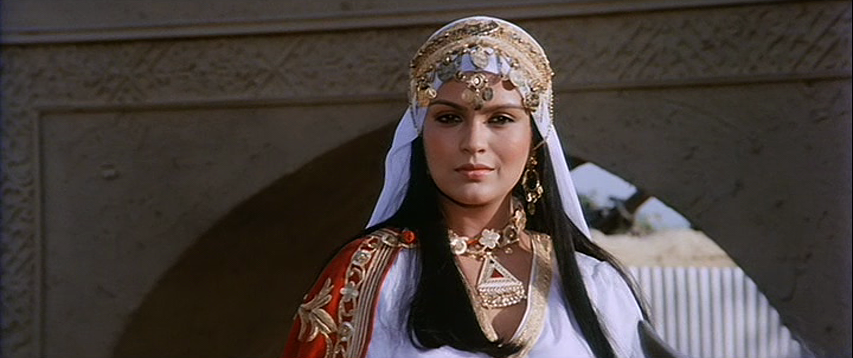
Zeenat Aman looking freakin gorgeous.
Hema Malini looking freakin much like Sridevi.
However as soon as he reaches the destination, a beautiful princess Marjeena falls into his arms (literally) and explains that her father has just been murdered by an usurper, who now is keen on marrying her. Alibaba and his father flee from the city, taking the princess (already in love of course) along with them. But (yes, another but) while on the run Yusuf is killed and Marjeena falls into the hands of a slave trader. Alibaba manages to buy her, but his greedy brother Quasim, who lent him the money, asks him to give up all possible rights on family property. To make a living for himself, Marjeena and also his old mother, Alibaba starts selling wood. While on one of his trips outside the city, he comes across the secret entrance of a cave, that serves the notorious Abu Hasan and his men as a lair and treasury. All he needs to say is a magic chant to be able to step inside...
Alibaba and Marjeena in the bandit´s lair. Private, but not the best place for romance.
The story after this features some more buts and howevers, and also some more WTFs. We get to see some magic, some greedy men, some more usurpators and also we get to see a princess and the woman she´s been chasing singing a song about which one of them is more sexy in a bar. Loads and loads of people swering they will kill Abu Hasan, so if you have not yet noticed he is the bad guy here, this should give you a hint.

As a little child I loved this fairytale, that figures even in Czech story books. The film was the joined effort of Indian and Soviet production, which only added to the attractiveness for me (think whatever you want about Soviet politics, but their movies were excellent). Hence it bears not only the unmistakable stamp of Bollywood (there are songs and dance, indian setting, family ties..) but also reminds us of beautiful Russian fairytales, especially as far as technical background is concerned. If we perceive the film purely as a fairytale, forgiving all the plot holes and some illogical editing, then it is sure to be enjoyable. Should we perceive it more „seriously“, then it does not live up to any standart really.
PARTY TIME!
The three main leads – Dharmendra as Alibaba, Hema Malini as Marjeena and Zeenat Aman as Fatima, give a rather luke-warm performances. Zeenat is the only one who delivers some emotion. Hema Malini in her „just a heroine“ role does not have the space and seemingly not even an interest to shine, the dances she is given are forgettable. Dharmendra is good, but that´s where it ends. All the songs are rather unfittingly forced into the story and the disco colour-flashing floor in the bandit´s lair made me wonder if the shooting took place on the remains of the Saturday Night Fever sets. The visuals were most of the time beautiful though, and so were the costumes. The fight and battle sequences are well done and very convincing – but the convincing bit left me rather uncomfortable because my heart was bleeding for all those horses that simply MUST have been hurt during the shooting.

In the end I can only repeat: If you´re looking for a simple watch and you are willing to let go of reality and logic, or if you are a fan of Dharmendra/Hema/Zeenat (who does look gorgeous by the way), it is not a bad film. If you´re nothing of the above, you can live peacefully without watching it.

Sunday, 13 March 2011

Yamla Pagla Deewana

Directed by: Samir Karnik
Starring: Sunny Deol, Bobby Deol, Dharmendra, Anupam Kher
Released: 2011


Somewhere in Vancouver, Canada, there lives a rather happy NRI going by the name of Paramveer Singh (Sunny Deol). His family includes a blonde, non-Indian wife, two little sons and old mother. Paramveer dreams of going back to his homeland, but his wife Mary is completely opposed to the idea, being completely convinced that all Indians are crazy (unfortunately the events that are about to happen will do anything but prove her wrong). And so Paramveer is left with his dreams and spends his days going to job and grocery shopping for his family. If somebody happens to have a brilliant idea of robbing him, he simply beats them up without a wink, then he buys the latest Punjab newspaper for his Maa and peacefully goes his way. But nothing lasts forever and one day the family learns, that Paramveer´s father (Dharmendra), who run away thirty years later after a fight with his wife and took his second son, a mere baby, with him, managed to bring little Gajodhar (Bobby Deol) to his own image AKA the two of them lie and loot and nobody is safe before them. Th grief-stricken Maa pleads Paramveer to take a trip to India and bring her husband and son to her, because after 30 years...well, she kinda misses them and believes once they come they will turn into angels. Paramveer, as a good son, does exactly what she asks and leaves at once to India.

And he is lucky – as soon as he sets his foot into the city of Banares, he becomes a victim to one of his brother´s deceptions (and it makes him happy!) and soon he finds also his rather drunken father in the company of a girl more then half his age (and it makes him even more happy!). The father does not want to confirm Paramveer´s identity, because he brought his little „Goju“ in belief he is a single-child and his mother had run away from them. But after Paramveer saves his skin more then once he accepts him to accompany him for a time. Meanwhile Goju has other troubles altogether. He is in love. After much thinking and many unsuccessful attempts at not making a complete fool of himself he finally wins over the girl he loves. Unfortunatelly she has five rather strickt brothers who immediatelly drag her home and are planning to wed her to the first NRI who would be willing. Goju is uhappy. But what would be the family for, right?
Deol & Deol

Yamla Pagla Deewana is basically from the same mould as Dabangg, but then it went a different way. It too has a nice desi touch and smells of the wonderful 90´s masala, but in the end the feeling one has is that the three Deols just really wanted to act together – even if for the heck of it. It would be futile to search for any message or a deep thought, you wouldn´t find one. It is a light comedy that simply happens and doesn´t ask for more then your laugh. Dharmendra, Bobby and Sunny all are basically playing caricatures of their most famous characters, especially Sunny, an honest guy with pure heart who will beat anyone up for his family and doesn´t even have to lift his hand (literally) and Dharmendra as a light-hearted Casanova with a weak spot for alcohol. The first half of the film concetrates on Paramveer looking for his father and brother and then his attempts to get closer to them. However the comical scenes could be counted on the fingers of one hand and it all rather drags at times too – contrary to the second half!
Deol and . . . eeeeeh . . . Deol.

That is where the fun really begins. The story turns almost grotesque and even finds a way how to quite seemlessly bring all the characters into one place. While in the first half the footage all belongs to the three Deols, in the second we have not only five Punjab brothers (one better – or worse? - then the other) and after a while even Paramveer´s blonde wife and two kids! Among the brothers Anupam Kher excells and every single of his appearances is hilarious. Of course we get to see some fighting scenes faithful to „Sunny Deol“ style and who would even dare to doubt it will all end well and Anupam Kher will not shoot anyone, nah?

I wouldn´t recommend the films to the Bollywood begginers, because there are some jokes related to several famous movies (Raja Hindustani and Sholay immediatelly come to mind), and also not everybody is ready for Johnny Lever (even though I must say he was not as half as crazy/funny/annoying as he usually is, and in fact I quite welcomed his appearance from purely sentimental reasons).

Music is nothing special, very forgettable and except for Chadha de rang the songs are not even visually pleasing.

If you´re a Deol fan – you are going to love it.